Access practical legal insights designed to help MSPs, information technology (IT) companies, and telecom provider navigate mergers and acquisitions, regulatory requirements, and complex business transactions with greater confidence.

Strategic Guides

Strategic Legal Guides for MSPs, IT Companies & Telecom Providers
Explore Our Strategic Guides
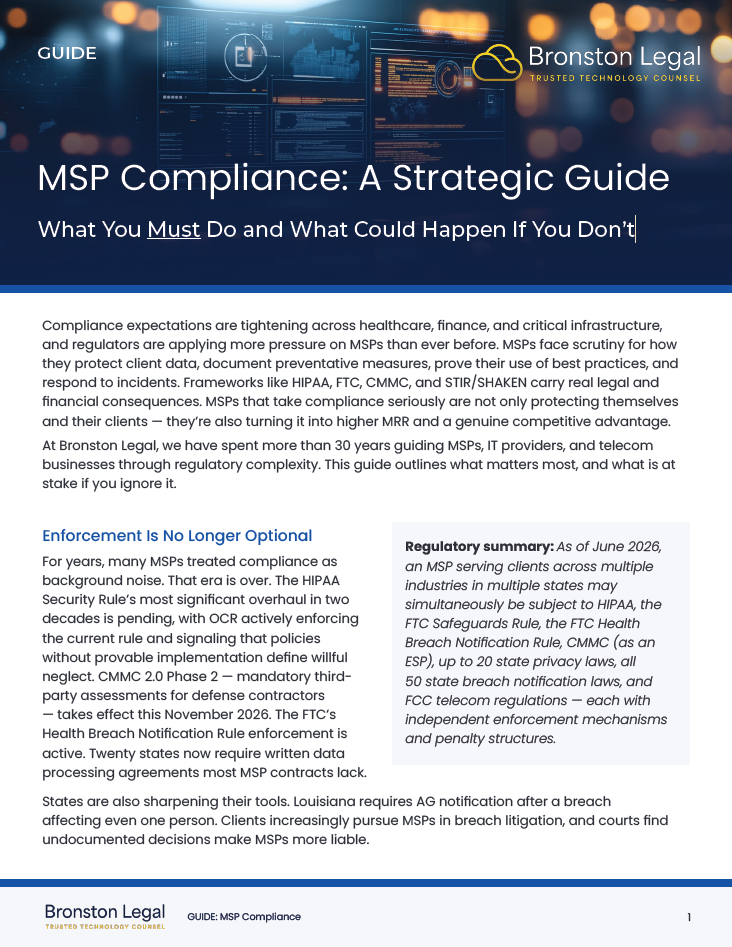
MSP Compliance: What You Must Do and What Could Happen If You Don’t
Regulatory pressure on MSPs has reached a tipping point in 2026, and the days of treating compliance as background noise are over. From the pending HIPAA Security Rule overhaul and active FTC enforcement to CMMC 2.0 Phase 2 taking effect this November, MSPs now face overlapping obligations across healthcare, finance, defense, telecom, and a 20-state patchwork of privacy laws — each with its own penalty structure and enforcement teeth. This guide from Bronston Legal cuts through the complexity, breaking down the eight regulatory frameworks every MSP needs to understand, the most common (and costly) places MSPs get into trouble, and the contractual and documentation gaps that turn a manageable incident into an existential one. You’ll also see how forward-thinking MSPs are turning compliance into a competitive advantage — winning regulated-industry clients, commanding better contract terms, and packaging compliance as a recurring revenue stream.
Download the guide for a clear, practical roadmap to protecting your business and growing it in today’s regulatory environment.
Download
Legal Considerations for MSP M&A: A Strategic Guide for Buyers and Sellers
This strategic guide outlines the key legal risks and considerations involved in managed service provider (MSP) mergers and acquisitions. Learn how to navigate due diligence, regulatory compliance, intellectual property ownership, contract transfers, cybersecurity risks, and deal structuring to protect enterprise value and avoid costly pitfalls. Designed for MSP owners, buyers, and investors, this guide provides practical insights to help ensure a smoother transaction and successful post-close integration.
Download the guide to gain practical insights that can help you navigate MSP transactions with confidence.
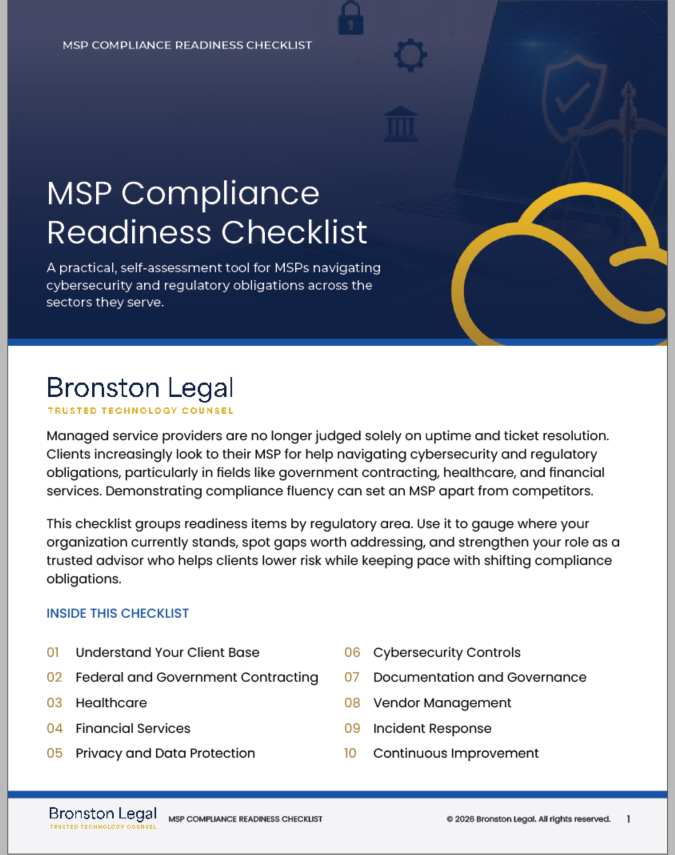
MSP Compliance Readiness Checklist
Managed service providers are no longer judged solely on uptime and ticket resolution. Clients increasingly look to their MSP for help navigating cybersecurity and regulatory obligations, particularly in fields like government contracting, healthcare, and financial services. Demonstrating compliance fluency can set an MSP apart from competitors.
This checklist groups readiness items by regulatory area. Use it to gauge where your organization currently stands, spot gaps worth addressing, and strengthen your role as a trusted advisor who helps clients lower risk while keeping pace with shifting compliance obligations
Frequently Asked Questions About MSP and Telecom Legal Strategy
What legal issues should MSPs consider in mergers and acquisitions?
MSP mergers and acquisitions involve several legal considerations, including customer contract transferability, intellectual property ownership, regulatory compliance, cybersecurity risk, and deal structure. Proper legal planning helps prevent post-closing disputes, regulatory delays, and unexpected liabilities.
What due diligence is required when acquiring an MSP?
Legal due diligence for an MSP acquisition typically includes reviewing customer agreements, service level agreements (SLAs), licensing and software subscriptions, employment agreements, cybersecurity policies, and regulatory compliance requirements. This process helps identify potential risks before closing the transaction.
How do telecom regulations affect MSP transactions?
MSPs that provide VoIP, UCaaS, or other telecom services may need to comply with federal and state regulations, including FCC filings or state regulatory approvals. These requirements can affect transaction timing and must be addressed early in the deal process.
Why are customer contracts important in MSP acquisitions?
Customer contracts often contain provisions related to assignment, service commitments, auto-renewal terms, and termination rights. Reviewing these agreements during due diligence helps ensure revenue continuity and reduces the risk of customer loss after the transaction.
Why is intellectual property important in MSP mergers and acquisitions?
MSPs frequently develop proprietary automation tools, scripts, and custom software. If intellectual property ownership is unclear or improperly documented, it can reduce deal value or create legal disputes after closing. Proper IP documentation and transfer are critical during the M&A process.