Bronston Legal helps MSPs meet overlapping regulatory obligations before they become costly enforcement actions.

MSP Compliance

Your Clients’ Compliance Problem Is Now Your Problem

Which Regulations Actually Apply to You?
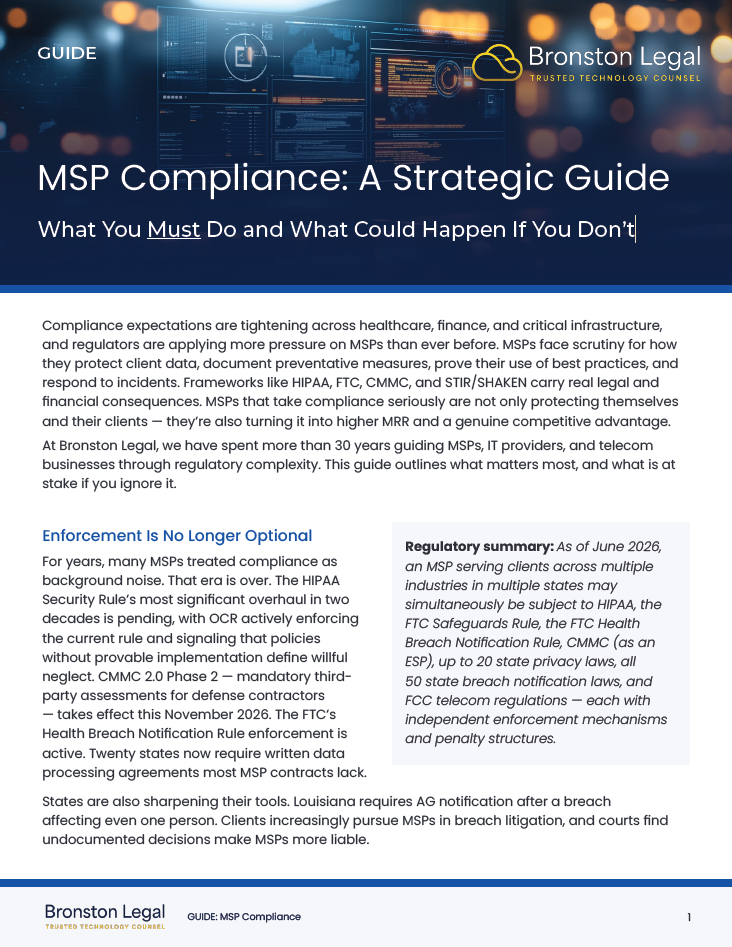
MSP Compliance: What You Must Do and What Could Happen If You Don’t
Regulatory pressure on MSPs has reached a tipping point in 2026, and the days of treating compliance as background noise are over. From the pending HIPAA Security Rule overhaul and active FTC enforcement to CMMC 2.0 Phase 2 taking effect this November, MSPs now face overlapping obligations across healthcare, finance, defense, telecom, and a 20-state patchwork of privacy laws — each with its own penalty structure and enforcement teeth. This guide from Bronston Legal cuts through the complexity, breaking down the eight regulatory frameworks every MSP needs to understand, the most common (and costly) places MSPs get into trouble, and the contractual and documentation gaps that turn a manageable incident into an existential one. You’ll also see how forward-thinking MSPs are turning compliance into a competitive advantage — winning regulated-industry clients, commanding better contract terms, and packaging compliance as a recurring revenue stream.
Download the guide for a clear, practical roadmap to protecting your business and growing it in today’s regulatory environment.
DownloadFrequently Asked Questions About MSP Compliance
Do MSPs need to comply with HIPAA?
Yes. If you manage IT systems for a healthcare provider, you’re typically a business associate under HIPAA and on the hook for its Security Rule requirements, including breach notification and a signed business associate agreement.
Does the FTC Safeguards Rule apply to MSPs?
It can. If you support financial institutions or handle customer financial data, you may need a written information security program under the rule, whether or not you think of yourself as “in finance.”
What is CMMC 2.0 and why does it matter to MSPs?
CMMC 2.0 is the Department of Defense’s cybersecurity certification framework. If you support defense contractors, you often have to meet its standards yourself, since the requirement flows down through the contract chain. Phase 2 takes effect in November 2026.ess.
Can an MSP be held liable for a client's data breach?
Yes, if your contracts or documentation don’t clearly spell out what you’re responsible for. Clear contract terms and real documentation are your best protection, and they’re both fixable before there’s ever a breach.