Your AI Contract Isn’t as Cheap as It Looks
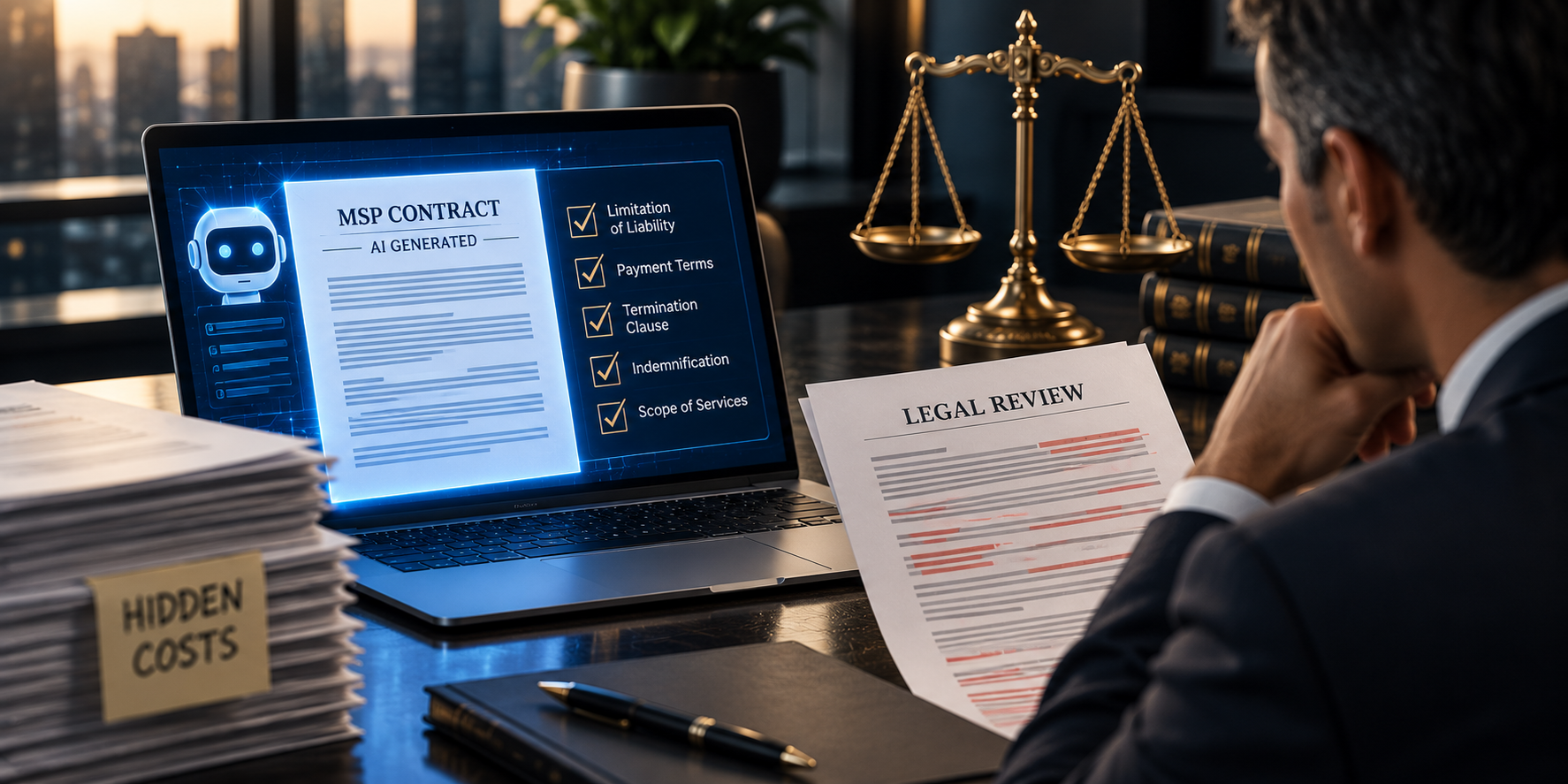
A managed service provider recently sent us an AI-generated MSP contract: a Master Service Agreement and Statement of Work he’d built with an AI drafting tool. He was proud of it. It had a limitation of liability, a payment section, a termination clause, all the parts a contract is supposed to have. He wanted a quick read-through before sending it to a new client.
What he got instead was an invoice that looked like what he would have paid to have it built from scratch.
That surprises most MSP owners. It shouldn’t. Reviewing a contract you didn’t write and don’t fully understand is not faster than writing one you do. In a lot of cases, it’s slower, because before an attorney can fix anything, they first have to figure out what’s actually there.
The Review Isn’t a Skim
When we draft an MSA from our own framework, or redline something built from a template we’ve already vetted, we know exactly where the risk sits. We know which clause protects your limitation of liability, which one ties your SLA remedies to your actual service metrics, and which one needs a state-specific carve-out. Review moves quickly because the provenance is known.
An AI-generated contract has no provenance. The tool that produced it pulled language from patterns in its training data, not from your business, your state’s law or the deal you actually negotiated. That means every clause has to be read as if it’s the first time anyone has seen it, checked against your actual operations, and traced back to figure out why it’s there before anyone can decide whether to keep it, cut it or rewrite it. That diagnostic step doesn’t exist when you’re starting from a document we already trust.
A Clause That Never Needed to Exist
Here’s a concrete example from a recent review. An MSP’s AI-generated MSA included a detailed provision addressing New York General Obligations Law Section 5-903, the statute governing when automatic renewal clauses in service contracts are enforceable in New York. The MSP doesn’t operate in New York. It has no New York customers and no New York exposure.
The AI tool had almost certainly pattern-matched “service contract” and “automatic renewal” to a well-documented compliance requirement and inserted language addressing it, without any way of knowing whether it applied. We had to identify the clause, research why a New York-specific renewal disclosure had been added to a contract with no connection to New York, confirm it created no obligation the MSP actually needed, and strike it.
None of that work would exist in a contract built for this MSP from the start. It only exists because something was added that didn’t belong, and someone had to notice.
Generic Language Creates Two Kinds of Problems, Not One
AI drafting tools are good at producing language that looks complete. They are much less reliable at producing language that reflects how your business actually delivers service, bills for it, or manages a vendor outage. That gap shows up in two directions at once.
First, there are gaps in protection. A generic SLA remedy that isn’t tied to your actual response-time metrics, a limitation of liability that isn’t capped against fees paid, an indemnification clause that doesn’t account for the fact that a third-party tool, not your own team, caused the outage. These are the protections an MSP-specific attorney builds in by default and a generic tool has no reason to include.
Second, there are additions that don’t belong, like the New York renewal clause above. Both problems require the same thing: a lawyer who knows what an MSP contract in your specific situation should and shouldn’t say, going through the document line by line to find both kinds of issues at once.
What “Fixing” an AI-Generated Contract Actually Involves
Fixing isn’t a light edit. It typically means:
- Reading every clause without assuming standard conventions were followed, because there’s no guarantee they were.
- Confirming governing law, venue and any state-specific requirements actually match where you do business.
- Cross-checking the MSA, SOW and SLA against each other for consistent defined terms and scope, since AI tools often generate these as separate documents that don’t fully align.
- Verifying the limitation of liability, indemnification and insurance requirements reflect your actual risk, not a generic default.
- Identifying anything inserted that doesn’t apply to your business, and confirming that removing it doesn’t leave a gap.
- Filling in the protections a generic tool has no way to know you need.
That’s substantially the same analytical work involved in drafting a contract from scratch, with an added diagnostic phase on top of it. It’s not a discount version of drafting. In many cases, it’s drafting plus detective work.
The Math Rarely Favors the AI Draft
The assumption behind most AI-generated contracts is that a quick attorney review afterward will be cheap, because most of the work is already done. In practice, review of an unfamiliar document is billed the same way drafting is, by the time it takes to get the document right, and an unfamiliar, generic or partially incorrect draft frequently takes longer to make correct than a document built the right way the first time.
That’s the part MSP owners don’t see coming. The AI draft feels like a head start. For a document with unknown provenance and no guarantee it reflects your business or your state’s law, it’s often closer to a detour.
When to Rebuild Instead of Redline
Not every AI-assisted document needs to be thrown out. If you started with an attorney-drafted agreement and used an AI tool only to update pricing or a term length, a review can be fast because the underlying structure is already sound. A rebuild is usually the faster, less expensive path when:
- Governing law and venue are generic or don’t match the state where you actually operate.
- The MSA, SOW and SLA use inconsistent definitions or don’t reference each other correctly.
- You handle regulated data, such as healthcare, financial or defense-adjacent information, but there’s no data processing or security addendum.
- The limitation of liability isn’t tied to fees paid, insurance coverage or your actual risk exposure.
A review is usually enough when the document was originally drafted by an attorney and only lightly updated with an AI tool, the changes are limited to pricing, term length or scope description rather than liability or risk allocation, you already have a Bronston Legal or comparable attorney-drafted agreement as the source document, or you just want a second set of eyes before a specific negotiation rather than a full audit.
If more of the first list applies to your documents, a flat-fee rebuild is usually faster and less expensive than paying to review and repair what you have. Bronston Legal’s MSP Contract Menu offers flat-fee Master Service Agreements, Statements of Work, Service Level Agreements and compliance addenda, individually or bundled into Gold and Platinum packages, so you know the cost before you start.
Frequently Asked Questions
Does having a lawyer review an AI-generated contract cost less than having one drafted?
Not reliably. Review of an AI-generated MSA or SOW often takes as long as drafting one, because the attorney has to identify what’s missing, what’s inaccurate and what doesn’t apply before making any corrections. The time saved by generating a draft quickly is frequently spent later diagnosing it.
Can AI tools like ChatGPT or Claude produce a legally enforceable MSP contract?
An AI-generated contract can be internally consistent and technically enforceable in a general sense, but enforceable is not the same as protective. These tools tend to generate generic language that does not reflect an individual MSP’s service delivery model, billing structure or state-specific legal requirements, which leaves real gaps in protection even when the document reads as complete.
What kinds of mistakes show up most often in AI-generated MSP contracts?
Common issues include state-specific clauses inserted without regard to where the business actually operates, SLA remedies that aren’t tied to real service metrics, limitation of liability language that isn’t capped against fees paid, and inconsistent defined terms across the MSA, SOW and SLA.
How can an MSP tell whether its AI-generated contract needs a review or a full rebuild?
A rebuild is usually the faster and cheaper path when the governing law doesn’t match where the business operates, the MSA and SOW don’t reference each other consistently, the business handles regulated data without a corresponding compliance addendum, or the liability cap has no connection to actual risk or insurance coverage.
Is it risky to send an AI-generated contract to a client before it’s reviewed by an attorney?
Yes. Once a contract is signed, both parties are bound by whatever it actually says, including anything the AI tool inserted incorrectly or failed to include. Errors that would have taken minutes to fix before signature can take significantly longer, and cost significantly more, to unwind afterward.
What does a flat-fee MSP contract package from Bronston Legal include?
Bronston Legal’s MSP Contract Menu includes a Base Package with a Master Service Agreement, Statement of Work, Service Level Agreement and Service Order/Quote Form, along with add-on documents like a Business Associate Agreement, Data Processing Addendum and Vendor and Subcontractor Risk Allocation Agreement. These can be purchased individually or as part of discounted Gold and Platinum bundles, each prepared by a Bronston Legal attorney at a fixed cost.
Key Takeaways
- An AI-generated MSA or SOW takes about the same legal review time as an attorney-drafted one, and often more, because the reviewing attorney has to diagnose the document before correcting it.
- AI drafting tools can insert language that doesn’t apply to your business, such as a state-specific statute for a jurisdiction you don’t operate in, which then has to be identified and removed.
- Generic AI-generated language frequently omits protections specific to how your MSP actually delivers service, bills clients and manages vendor risk.
- Signing an AI-generated contract before legal review carries real risk, since both parties are bound by anything the tool got wrong.
- When an AI-generated draft doesn’t match your state’s law, doesn’t align across the MSA, SOW and SLA, or misses required compliance addenda, a flat-fee rebuild is usually faster and less expensive than a full review and repair.
Not Sure Whether Your Contract Needs a Redline or a Rebuild?
That’s a conversation worth having before anything gets sent to a client, not after. Bronston Legal, an award-winning, nationally recognized IT and telecom law firm, can tell you honestly and quickly whether your MSA and SOW need a targeted review or are better replaced with one of our flat-fee MSP contract packages.
Contact Bronston Legal at techlawyers.com/contact-us/
This article is provided for general informational purposes and does not constitute legal advice. The application of HIPAA depends on the facts of each relationship, the services provided, the data involved, and the governing agreements.
© 2026 Bronston Legal. All rights reserved.